
Rusty Pickett Never Told Me What Year It Was
Finding Rusty Pickett's Place in Time
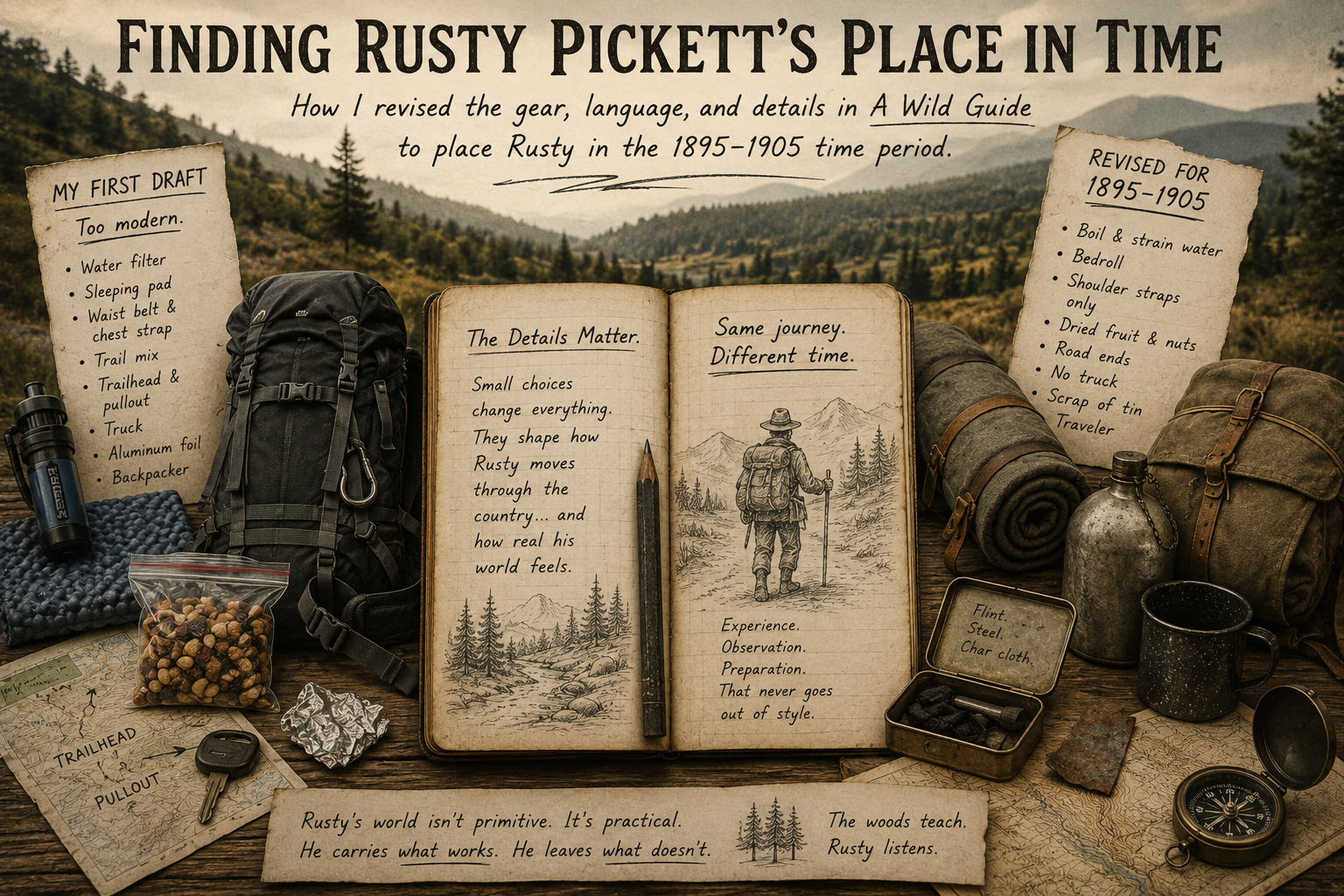
Sometimes the smallest details tell the biggest story. As the journal entries for A Wild Guide evolved, I found myself replacing modern objects and terminology with period-appropriate alternatives to better place Rusty Pickett somewhere around 1895–1905. The journey didn't change. The world he traveled through did.
When I first started writing Rusty Pickett’s journals, I did not know exactly when he lived.
I knew the pages should feel old. I knew his equipment should be simple, practical, and well used. I knew his world should exist before wilderness travel became crowded with modern terminology, brightly colored gear, and specialized equipment designed to solve every inconvenience.
That seemed like enough.
It wasn’t.
At first glance, Rusty’s journals already felt removed from the present. There were no phones, GPS units, synthetic jackets, satellite messengers, or other obvious signs of modern life. He traveled with a map, compass, hatchet, cook pot, journal, and a small fire kit. He slept beneath a tarp, cooked over coals, watched the weather, and paid close attention to the country around him.
The larger pieces felt right.
The smaller ones began causing trouble.
Rusty carried a portable water filter.
He slept on a sleeping pad.
His pack had a waist belt and chest strap.
He ate trail mix.
He met another hiker at a trailhead beside a pullout.
Near the end of the journey, he expected to walk back to his truck.
None of those details seemed especially important while I was drafting. Most passed through the story without drawing much attention. Together, though, they placed Rusty in a much more modern world than the one I had imagined.
The problem became harder to ignore once Rusty discovered the remains of an old high-country homestead.
The wooden structure was gone. The roof and walls had long since weathered back into the country. What remained was stonework, a faint foundation, a few stubborn traces, and the quiet evidence of decisions made by someone who had known the land long before Rusty arrived.
The woods needed time to do that work.
Rusty could not simply be twenty years removed from the person who built that place. Harsh winters, wet seasons, insects, rot, and time had taken nearly everything made of wood. What remained had survived because stone lasts longer than timber and because good decisions sometimes leave traces after the person who made them is gone.
That discovery forced me to ask a question I had been avoiding.
When does Rusty Pickett actually live?
I eventually settled on approximately 1895 to 1905 as the working period for this particular journal.
That range gives Rusty access to manufactured matches, a compass, surveyed maps, metal tins, canvas equipment, and other practical goods without making him feel like a modern recreational backpacker. It also creates enough distance between Rusty and the earlier homestead for the place to have nearly disappeared while its stonework and faint trails remain.
I may never place a precise year on the journal page.
Rusty knows when he lives. He has no reason to explain it to himself.
I still need to know.
Once I chose that period, I began scrubbing the manuscript for anything that argued with it.
My first concern was the fire kit.
I had previously imagined cotton balls among Rusty’s emergency tinder. Cotton itself was not the problem. Petroleum jelly also existed by the late nineteenth century. Technically, the materials could have been available.
But cotton balls coated in petroleum jelly felt like a modern bushcraft trick.
That distinction became important.
Something can be historically possible and still feel historically wrong.
Rusty did not need the cotton balls anyway. Flint, steel, and char cloth suited him better. They fit the period, fit his experience, and made the fire-building process feel more connected to his own judgment.
That was the easy change.
The portable water filter was not.
Rusty used it more than once. He carried it in the side pocket of his pack and pumped creek water through it into a bottle. The scenes worked from a practical standpoint, but the object belonged to a much later style of wilderness travel.
The filter had to go.
That meant the water scenes could no longer be solved by pulling out a device and pumping until the bottle was full. Rusty now had to study the source, consider what lay uphill, strain cloudy water through cloth when necessary, and boil what he did not trust.
Removing the filter did not make him less capable.
It made his capability more visible.
The same thing happened throughout the manuscript.
His sleeping pad became a bedroll.
Trail mix became dried fruit and nuts.
A backpacker became another traveler.
The trailhead became the place where the road gave out.
A scrap of aluminum foil became a piece of old tin.
His pack lost its padded waist belt and chest strap. During a creek crossing, he still needed a way to escape the pack if the current took his feet, but the solution became simpler. He loosened the shoulder straps so the load could come free quickly.
The lesson remained.
Only the equipment changed.
Some objects required more thought.
Matches, for example, did not need to disappear. Manufactured matches fit the chosen period, and Rusty’s relationship with them helped reveal his character. He appreciated their usefulness but still preferred flint, steel, and char cloth when time allowed.
Cameras also existed, but mentioning one caused readers to begin wondering exactly what kind of camera Rusty knew about and where he had seen it. The reference was not necessarily wrong. It simply risked drawing attention away from the morning he was trying to describe.
The truck created an even larger decision.
Early motor vehicles existed around the turn of the twentieth century, but a truck waiting at the end of a remote route immediately narrowed the timeline. It also made the trailhead and pullout feel less like isolated terms and more like parts of a modern recreation system.
Changing the truck to a road preserved the journey without fixing Rusty to a particular machine.
That is one of the benefits of a working historical range instead of a declared date.
I can know the boundaries without forcing Rusty to announce them.
The process also changed how I thought about his equipment as a whole.
A tarp could remain, but it needed to feel like canvas or oilcloth rather than lightweight synthetic fabric.
A pack frame could remain, but it needed to feel like a wooden frame or packboard with canvas, leather, and simple lashings.
Water bottles became canteens.
A sleeping bag became less certain. Bedrolls, blankets, and an oilcloth ground layer felt more natural for the world I was building.
Even ordinary words required attention.
“Trail mix” is only nuts and dried fruit, but the phrase belongs to a later recreational culture.
“Backpacker” describes exactly what Rusty is doing, but it also describes a modern identity.
“Emergency gear” sounds like a category printed on a store shelf.
Rusty would be more likely to describe something by what it did, where he carried it, or why he had saved it.
These are small changes.
They add up.
Historical atmosphere is rarely ruined by one dramatic mistake. More often, it leaks away through a collection of ordinary details that feel just a little too familiar.
A plastic buckle never needs to appear if the language already suggests one.
A modern trail sign never needs to be described if the word “trailhead” has already built the parking lot in the reader’s mind.
The most useful part of this revision has been realizing that making Rusty’s world older does not mean making it primitive.
Rusty still carries manufactured goods.
He still benefits from maps, matches, metal tools, and equipment made by other people.
He is not living before technology.
He is living before wilderness travel became surrounded by the particular tools and language we now associate with modern backpacking.
That distinction matters.
Rusty’s competence should come from experience, preparation, and attention. His equipment supports those qualities, but it should not replace them.
Without a pump filter, he reads the water.
Without a modern pack suspension system, every item has to justify its weight.
Without a marked trailhead, he has to understand where the road ends and the country begins.
Without a sleeping pad, choosing dry ground matters more.
Without modern terminology, his journal sounds less like an outdoor manual and more like a private record written by a man trying to remember what worked.
The revisions did more than make the journal feel older.
They made Rusty more like Rusty.
I still do not know whether the finished journal will state a precise year.
It may not need to.
The date can remain outside the pages, quietly guiding the manuscript from behind the scenes.
Somewhere around 1895 to 1905, Rusty Pickett shoulders an old pack, checks the weather, and walks beyond the place where the road gives out.
That feels about right.
Continue the Journey
For more about how Rusty’s journals fit within the larger series, read The Book That Became Many Journals.
For a closer look at Rusty’s reasons for recording a journey, read Before Memory Changes It.