The Book That Became Many Journals
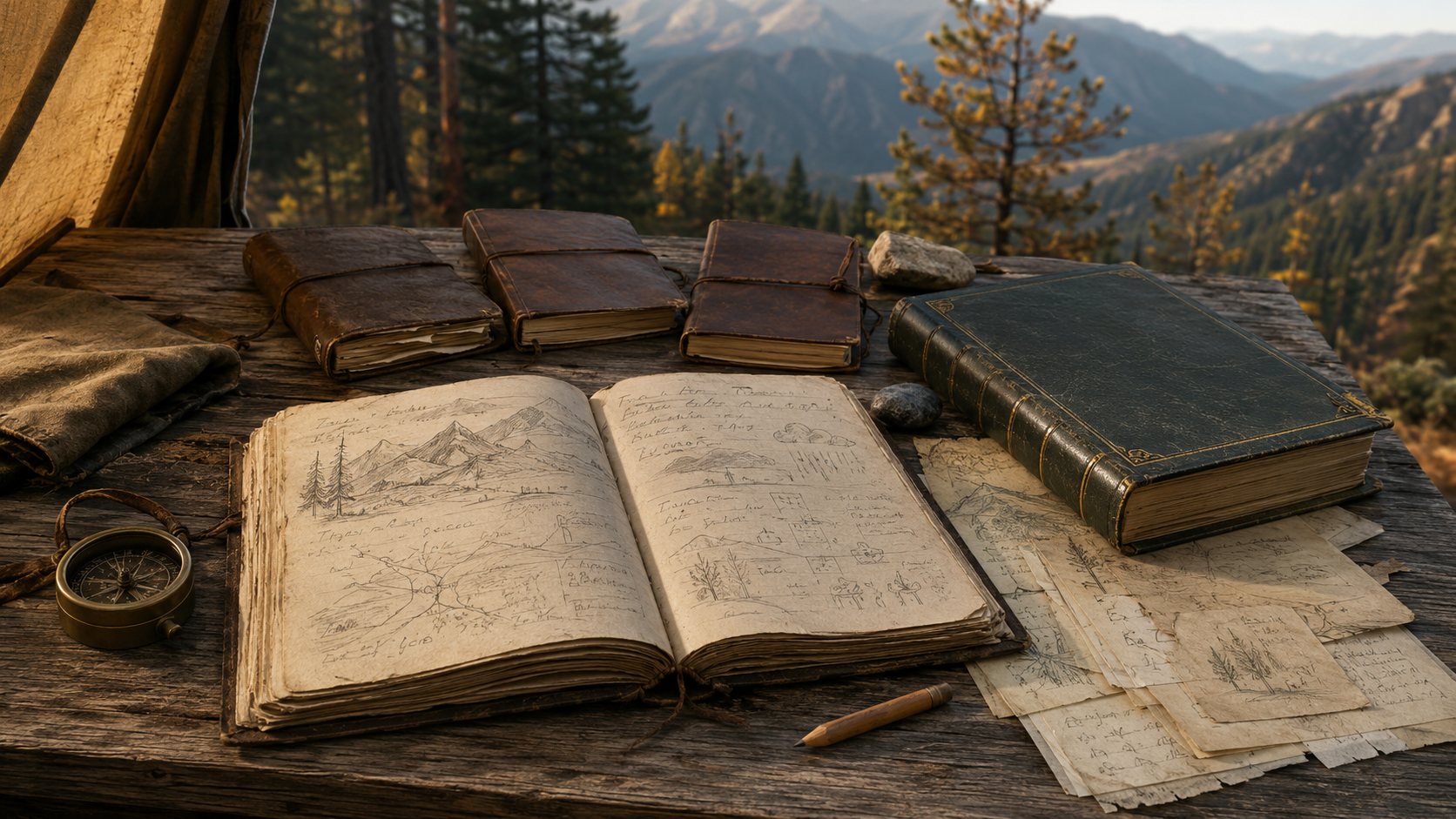
What began as one wilderness guide became a collection of complete journeys, each recorded in a field journal of its own.
What began as one wilderness guide became something larger when Rusty Pickett needed more than one journey.
The original idea seemed simple enough.
I would write a book called A Wild Guide.
It would look and read like the field journal of an old wilderness traveler named Rusty Pickett. Instead of presenting outdoor skills as instructions in a traditional guidebook, Rusty would record what happened during his days outdoors. The lessons would emerge naturally from changing weather, difficult decisions, small mistakes, and the practical work of moving through wild country.
That was the plan.
Then Rusty started walking.
The first journey took him into a mountainous region called Whitaker’s High Country. He crossed creeks, made camp, dealt with cold rain, watched the weather change, and recorded the things he noticed along the way.
The journal began to feel real.
That created a problem.
There were far more lessons waiting for The Crew than Rusty could reasonably encounter during one trip through the mountains.
He could write about keeping his feet dry, choosing a campsite, building a fire in wet weather, reading mountain clouds, or finding safer water near a high-country creek.
But how was that same journey supposed to teach someone how to find water in the desert?
It couldn’t.
Rusty could not step out of a mountain valley one morning and conveniently find himself crossing dry country simply because I needed another outdoor skill for a future story.
I could force the lesson into the journal.
I could have Rusty stop in the middle of his journey and explain what he might do somewhere else.
But that would change the nature of the book.
Rusty does not sit down to write a wilderness manual. He records the day he actually lived.
If he is cold, he writes about the cold.
If his matches are wet, he writes about the matches.
If he finds water, loses the trail, notices tracks, or makes a decision he later regrets, those things belong on the page because they happened.
A lesson about finding water in the desert belongs in a desert.
That meant Rusty would need another journey.
Then another.
The more I considered the outdoor knowledge that might eventually find its way into Journeys Of The Crew, the clearer the problem became. No single trip could hold all of it without feeling arranged for the reader’s convenience.
Rusty needed mountains.
He needed deserts.
He needed forests, plains, rivers, snow, heat, and long stretches of country where the problems would be different from the ones he had faced before.
A Wild Guide was becoming too large for one journey.
The obvious solution was to let it cover several journeys.
That created a second problem.
If Rusty kept a journal during each trip, including every entry from every journey would make A Wild Guide enormous. More importantly, it would no longer feel like one journal that had accompanied him into the field.
A single notebook could not reasonably travel through every season, landscape, and year of Rusty’s life.
The pages from Whitaker’s High Country belonged together.
They shared the same weather, the same route, and the same unfolding journey. Quiet entries mattered because they sat beside difficult ones. Decisions made early in the trip shaped what happened later. Even the days without a dramatic lesson helped reveal who Rusty was and how he moved through the country.
Pulling only the most useful entries out of that journey would solve one problem, but it would create another.
The complete journey would disappear.
That was when the structure finally made sense.
The manuscript I had been calling A Wild Guide was not one finished guide.
It was Rusty Pickett’s first field journal.
Field Journal no. 1
October to November
Whitaker’s High Country
It would contain the complete record of that particular journey, including the entries that might never be selected for anything else.
Future trips would have journals of their own.
Each one could remain honest to its place and conditions. Rusty would not need to manufacture a lesson simply because I wanted to include it. The country could determine what happened, and Rusty could write about what the day gave him.
A Wild Guide could then become something different.
Instead of being one journal from one trip, it could eventually gather selected entries from many of Rusty’s field journals.
An entry about wet matches might come from Whitaker’s High Country.
A lesson about finding water might come from a later journey through dry country.
Another entry might come from a winter trip, a river journey, or somewhere I have not yet sent Rusty.
Together, those selected pages could become the wider guide I originally imagined.
The change also gave me something I had not expected.
It gave Rusty a life beyond the lessons The Crew will eventually need.
His journals no longer have to exist only to supply material for other books. They can record complete journeys, including the wrong turns, quiet camps, changing weather, unnecessary worries, small discoveries, and moments that may never become part of A Wild Guide.
Those pages still matter.
Perhaps they matter more because nobody wrote them for a guide.
Rusty did not know which of his observations might someday help someone else. He simply wrote down the day as it happened, before memory had a chance to improve it.
What began as one book has now become a collection of journeys.
Whitaker’s High Country is the first.
Others will take Rusty into different country, present different problems, and fill new journals with lessons he could only have learned by being there.
Someday, selected entries from those journals may sit together inside A Wild Guide.
But first, Rusty has to live them.
Continue the Journey
To see the field-journal approach at work in one small entry, read Three Wet Matches and a Bad Decision.
For another challenge that emerged while developing Rusty’s journals, read Rusty Pickett Never Told Me What Year It Was.