The Rule I Keep Breaking
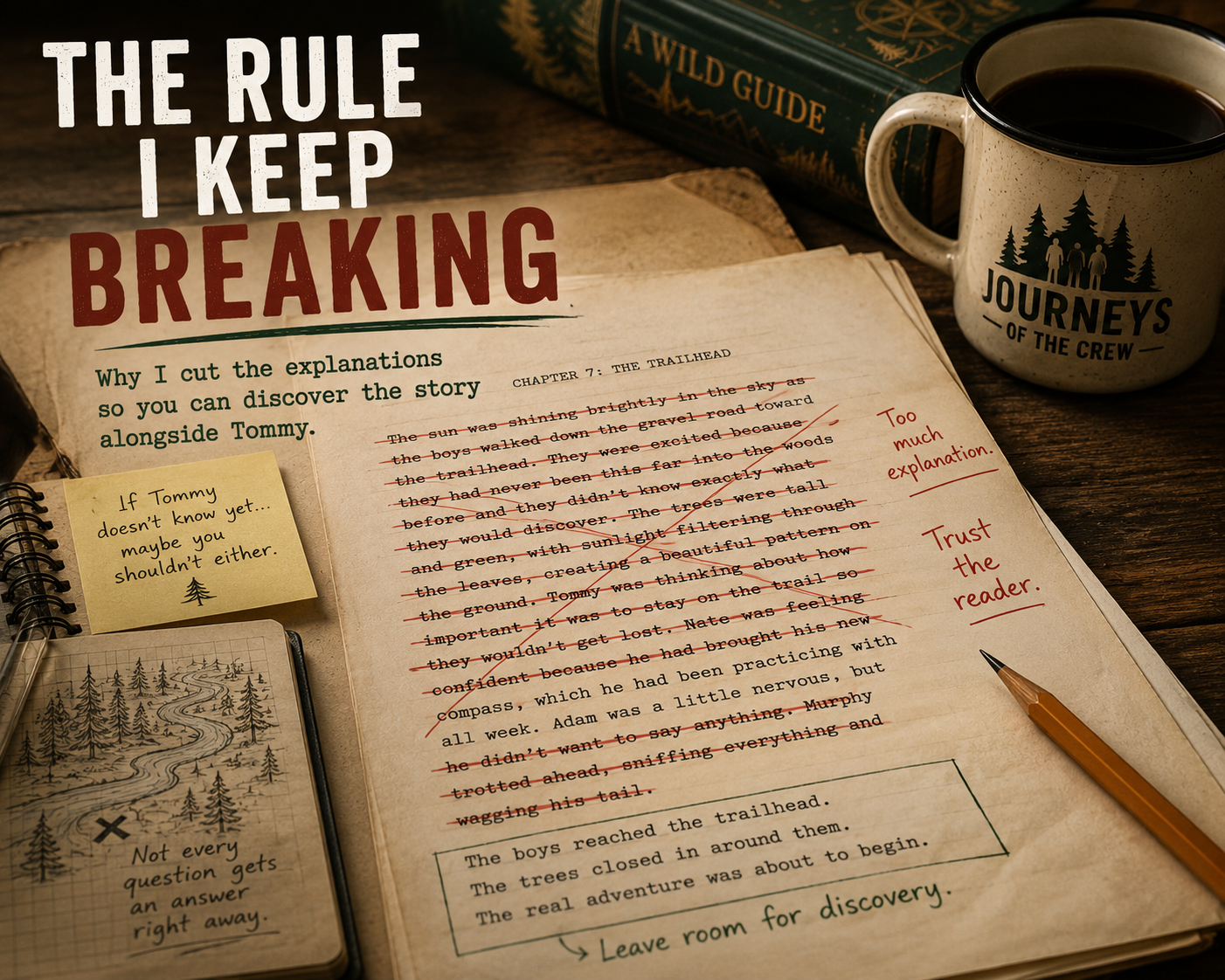
Cutting unnecessary explanations leaves room for readers to make discoveries alongside the characters. Sometimes the hardest writing rule is simply to trust the reader.
Here's a confession.
I keep trying to explain too much.
If you ever looked at one of my early drafts, you might think I don't trust my readers.
Because I explain...
Everything.
Why a character did something.
What a place looks like.
How a mystery works.
Sometimes I even explain what a character is already thinking.
It's a habit.
One that I keep fighting.
And one that I keep losing.
At least at first.
The funny part is that I usually don't notice I'm doing it until I read the chapter again a few days later.
Then I start deleting.
A sentence disappears.
Then a paragraph.
Sometimes an entire page.
Not because it was poorly written.
Because it didn't belong.
I've learned something while writing Journeys Of The Crew.
Readers don't want every answer.
They want the chance to find those answers for themselves.
That sounds obvious.
It isn't.
As a writer, I know what's happening behind the scenes. I know why a trail matters, why someone makes a certain decision, or why an object appears when it does.
My instinct is to tell you.
Instead, I'm learning to stay quiet.
To let the characters wonder.
To let readers notice something before it's explained.
Or maybe never explain it at all.
Because not every question needs an immediate answer.
Some questions are more enjoyable when you carry them with you for a while.
Children are especially good at this.
They notice patterns.
They remember details.
They connect clues that appeared chapters apart.
They enjoy discovering something instead of having it handed to them.
Every time I explain too much, I accidentally steal a little bit of that experience.
So I delete.
Not because less is always better.
Because discovery is better.
It's a strange feeling to spend an hour writing a page only to spend another hour removing half of it.
But almost every time I do, the story breathes a little easier.
The reader has more room.
More room to wonder.
More room to notice.
More room to explore alongside Tommy instead of following behind him.
That has quietly become one of the guiding principles behind Journeys Of The Crew.
If Tommy doesn't know yet...
Maybe you shouldn't either.
After all, half the fun of an adventure is discovering what's around the next bend.
Continue the Journey
For another look at the work that should disappear behind the finished story, read The Things You’ll (Hopefully) Never Notice.
For a glimpse of the unfinished pages where many of those decisions begin, read This Page Will Never Be in the Book.