

No One Sees the Whole Trail
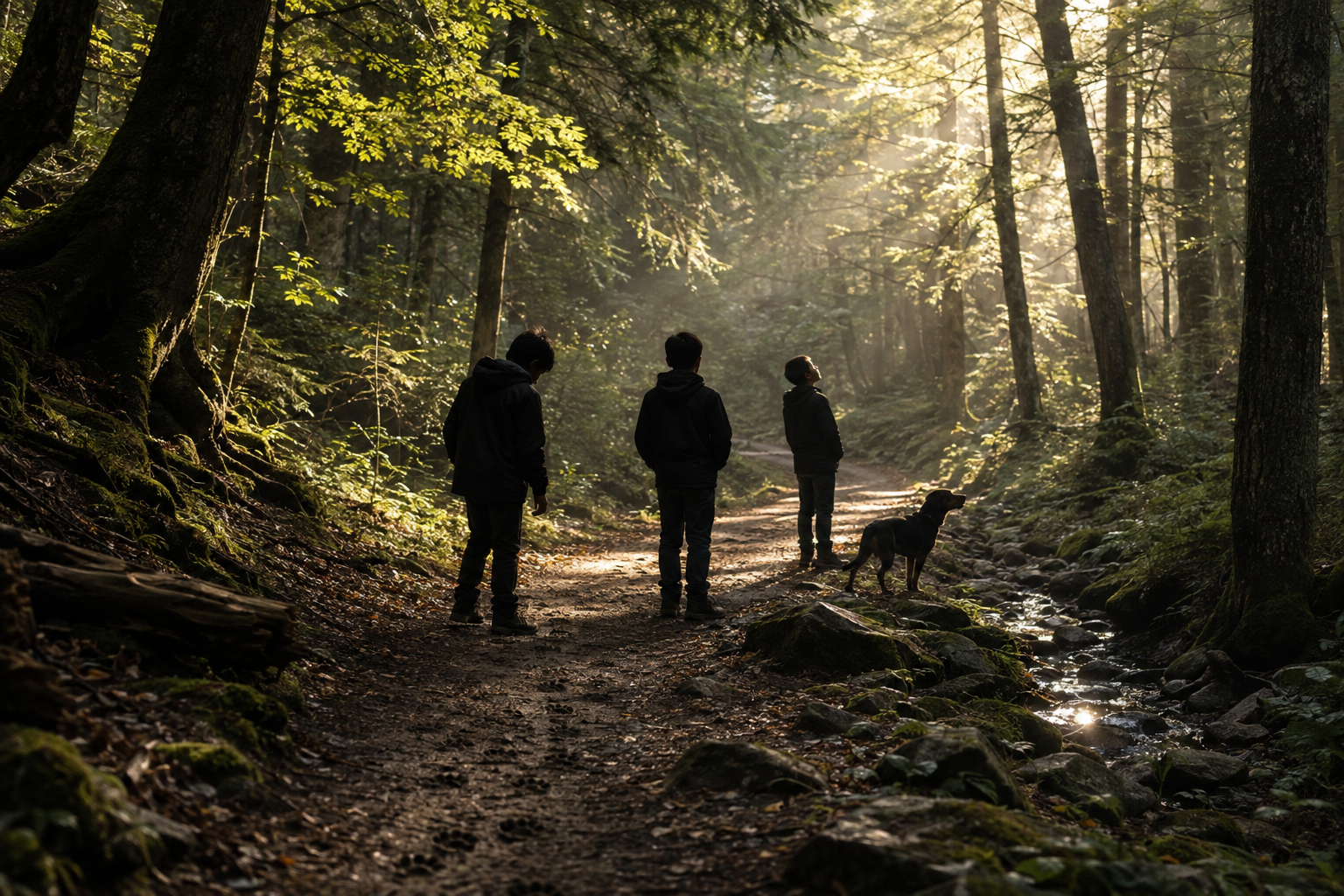
No one sees the whole trail. Each member of The Crew notices something different, and together, they see more.
How each member of The Crew notices something the others miss.
Put Tommy, Nate, Adam, and Murphy on the same trail and they will not have the same walk.
Tommy may notice that a mark on one tree resembles something they saw earlier.
Nate may notice a faint opening through the brush and wonder where it leads.
Adam may notice the clouds building behind them and calculate how much daylight remains.
Murphy may stop, lift his head, and listen to something none of the boys can hear.
Same trail.
Four different versions of it.
When I first began developing Journeys Of The Crew, the characters were much simpler.
Tommy was thoughtful.
Nate was energetic.
Adam was cautious.
Murphy was the dog.
Those descriptions were enough to begin writing, but they were not enough to make The Crew feel real.
The problem became most obvious whenever something important needed to be discovered.
Because Tommy is the main character, my first instinct was to let him notice it.
A mark on a tree?
Tommy saw it.
An unusual set of tracks?
Tommy found them.
A detail that did not belong?
Tommy stopped and pointed it out.
That worked for a while.
It also made everyone else feel as if they were walking behind him.
Tommy may be the character through whom readers experience much of the story, but that does not mean he should always be the first person to see what matters.
In fact, the more I thought about it, the less believable that seemed.
People do not enter a place and notice the same things.
A photographer may notice the light.
A birdwatcher may recognize a call from somewhere in the trees.
A child may spot a narrow path adults have walked past repeatedly.
Someone who has spent years outdoors may notice that the wind has changed without consciously deciding to check it.
We see the world through our interests, experiences, habits, and worries.
The Crew should too.
Tommy tends to hold onto questions.
He studies things and looks for connections. Something he notices now may remind him of something they passed earlier. A detail may not mean much by itself, but Tommy is likely to wonder how it fits with everything else.
His attention often becomes understanding.
Nate sees possibility.
Where Tommy may pause to study a faint path, Nate is already wondering where it goes.
He notices the opening through the trees, the rock that might provide a better view, or another way around a problem. His energy carries The Crew into places that careful consideration alone might never reach.
Sometimes that movement is exactly what the group needs.
Sometimes it means Nate is halfway there before anyone has decided whether going is a good idea.
Adam notices what does not feel right.
That does not mean he is afraid of everything or exists only to tell the others no.
His attention is practical.
He may notice the mud everyone is about to walk through, the missing item nobody realized they left behind, or the clouds gathering in the direction they will eventually need to travel.
Sometimes Adam’s concerns may prove unnecessary.
Other times, he may be the reason a small problem stays small.
Then there is Murphy.
Murphy experiences the same woods through an entirely different set of senses.
He hears what the boys cannot.
He catches scents they never knew were there.
He may stop before they understand why or turn his attention toward something outside their field of view.
That does not mean Murphy always knows what is happening.
He is not a magical warning system sent ahead to solve every mystery.
He simply gives The Crew information they could not have gathered on their own.
A raised head does not provide an answer.
It gives the boys another question.
Once I began thinking about the characters this way, their differences became more useful.
Nate did not need to become less energetic. His energy could reveal possibilities.
Adam did not need to stop being cautious. His caution could uncover risks and inconsistencies.
Murphy did not need to lead them directly toward every discovery. His reactions could remind them that the world extends beyond what they can see.
Tommy did not become less important when the others began noticing more.
He became part of a stronger Crew.
That distinction matters to me.
I do not want one capable child surrounded by characters who exist only to follow him. I want each member of The Crew to change what the group sees, considers, and ultimately decides to do.
Sometimes Tommy will recognize the connection.
Sometimes Nate will find the opening.
Sometimes Adam will notice the problem.
Sometimes Murphy will hear what is waiting beyond the next bend.
And sometimes they will all miss something.
Mr. Nash brings another perspective when he joins them. He sees the woods through experience, memory, and his own history. But even experience does not allow him to notice everything, and his presence should not make the boys’ observations less valuable.
No one sees the whole trail.
Perhaps that is one of the reasons we form crews in the first place.
Not because everyone sees the same thing.
Because someone else may notice what we missed.
Continue the Journey
For a closer look at how one member of The Crew became a fully realized character, read The Day Tommy Stopped Being an Idea.
For more about the kind of adventure these different perspectives help create, read Why Adventure Doesn’t Need Dragons.